
How to Build a Morning Routine That Actually Sticks (For Dads)

By Jack Willis • July 22, 2026
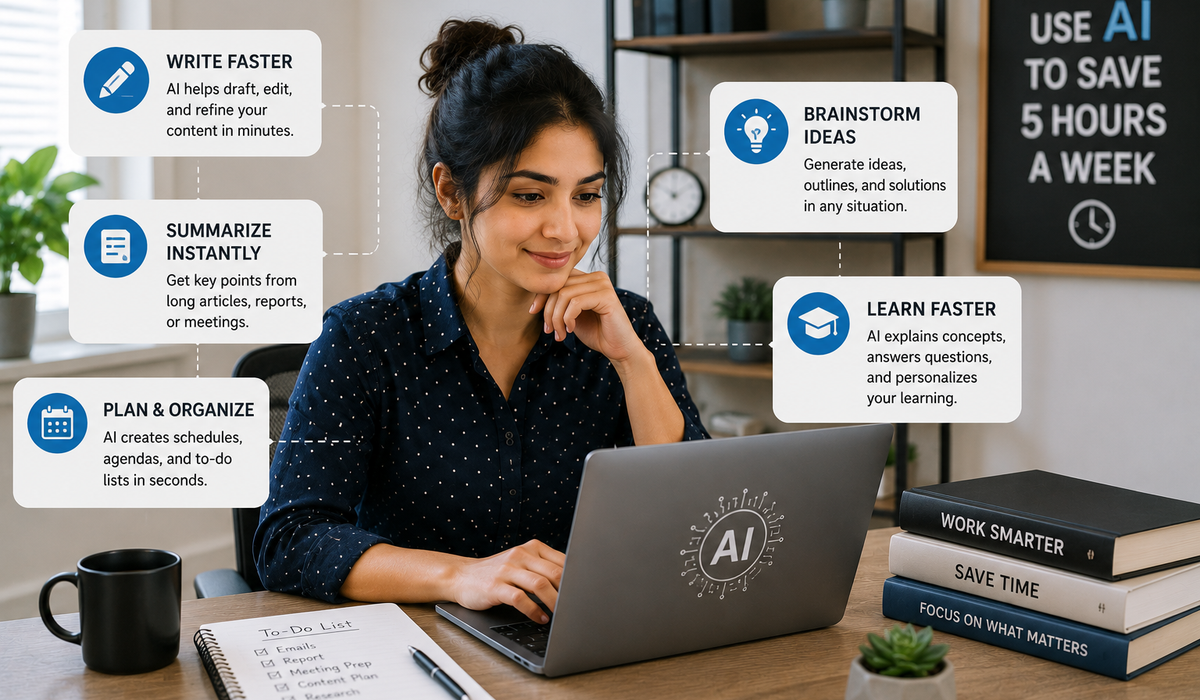
Artificial intelligence is no longer just a tool for programmers or large companies. Today, AI can help anyone work more efficiently, whether you’re managing emails, planning projects, studying, creating content, or organizing everyday tasks. The biggest benefit isn’t replacing your work—it’s reducing the time spent on repetitive or time-consuming activities.
You don’t need to use AI for everything to see meaningful results. By applying it strategically to the right tasks, many people can save several hours each week while improving the quality of their work.
Writing is one of the biggest time drains in many jobs. Emails, meeting summaries, reports, social media posts, and presentations can quickly consume hours of your week.
AI can help generate first drafts, rewrite text in different tones, proofread documents, summarize long articles, and improve grammar and clarity. Instead of staring at a blank page, you can start with a solid draft and spend your time refining it.
This doesn’t eliminate the need for human review. Always check facts, personalize important messages, and ensure the final version reflects your own judgment and voice.
Using AI as a writing assistant—not a replacement—can significantly speed up everyday communication.
Many professionals spend hours reading lengthy reports, research papers, meeting notes, or industry news.
AI can quickly summarize long documents, highlight key points, explain complex topics in simpler language, and compare information from different sources. This allows you to understand the main ideas much faster while deciding which materials deserve a closer read.
Rather than replacing careful reading when accuracy is critical, summaries help you prioritize where to focus your attention.
Saving even 20 minutes each day on reading adds up to hours over the course of a week.
AI can act as a personal planning assistant for both work and personal life.
It can help create meeting agendas, build project timelines, organize to-do lists, generate travel itineraries, prepare study schedules, or develop meal plans based on your preferences.
Instead of starting every plan from scratch, AI provides a structured foundation that you can customize to fit your specific needs.
Reducing the mental effort required for planning also frees up energy for more important decisions.
Creative work often begins with generating ideas, but getting started can sometimes be the hardest part.
AI can help brainstorm article topics, marketing campaigns, business names, presentation outlines, interview questions, product ideas, or solutions to everyday problems. It can also offer different perspectives that help you move past creative blocks.
The goal isn’t to accept every suggestion. Instead, use AI as a brainstorming partner that expands your options and stimulates new thinking.
Human creativity remains essential when choosing, refining, and implementing the best ideas.
AI can function as an on-demand tutor across a wide range of subjects.
Whether you’re learning a programming language, studying for an exam, improving your writing, practicing a foreign language, or understanding financial concepts, AI can explain ideas step by step, answer follow-up questions, and adapt explanations to your level of knowledge.
Instead of spending time searching across multiple websites, you can ask targeted questions and receive personalized guidance immediately.
Learning becomes more interactive and often much more efficient.
AI is a powerful productivity tool, but it isn’t perfect.
It can make mistakes, misunderstand context, or generate information that sounds convincing but is inaccurate. That’s why important decisions, factual claims, financial advice, legal matters, and professional communications should always be reviewed carefully before acting on AI-generated content.
Think of AI as a capable assistant rather than an infallible expert. It can help you work faster, but your judgment remains the most important part of the process.
The people who benefit most from AI aren’t necessarily those who use it the most—they’re the ones who use it intentionally. By delegating repetitive writing, summarizing information, organizing plans, brainstorming ideas, and accelerating learning, you can reclaim several hours each week without sacrificing quality. Used thoughtfully, AI doesn’t replace your expertise—it gives you more time to apply it where it matters most.

Fatherhood has changed significantly over the past few decades. While previous generations often focused primarily on providing financially for their families, many fathers today are embracing a broader role—one that includes caregiving, emotional support, household responsibilities, and active involvement in their children’s everyday lives.

Every family, workplace, or group of friends seems to have someone who quietly carries more than anyone realizes. He’s the one people depend on when something goes wrong. He stays calm during difficult moments, solves problems without complaining, and keeps moving forward even when life feels heavy.

Fatherhood isn’t usually defined by one extraordinary moment. It’s built through thousands of ordinary ones—making breakfast before school, showing up to soccer practice, reading one more bedtime story, listening after a difficult day, and being there when your child simply needs you.

Not every week is about chasing big goals or celebrating major achievements. Some weeks are simply about keeping everything moving—meeting deadlines, looking after your family, managing responsibilities, and finding enough energy to do it all again tomorrow.

Some dads seem to stay calm no matter what life throws at them. They handle busy mornings, unexpected setbacks, work stress, and family responsibilities without appearing constantly overwhelmed. It isn’t because their lives are easier or because they never feel stressed. More often, it’s because they’ve developed habits that help them respond thoughtfully instead of reacting emotionally.

Many people start an exercise routine with enthusiasm, only to stop a few weeks later. The problem usually isn’t a lack of motivation—it’s trying to follow a plan that doesn’t fit real life. Long workouts, unrealistic expectations, and an all-or-nothing mindset often make consistency difficult.